
The Acropolis of Athens
|
What would a visit to Athens be without going to the Acropolis to see the Parthenon? And still people ask me why the Parthenon is so important. It's because it was the most perfect building built by the world's most advanced civilization and even though we have been studying it for centuries we are still not sure how they did it. |
|
|
|
Note: Because of long lines from the cruiseships during tourist season try to visit the Acropolis before 9am or after 4pm. The Acropolis is the one historical site you can't miss. You can take a tour or wander up there yourself but during the summer, whatever you do, unless it is overcast, go early or late in the day. It can get very hot up there and gasping for breath can take way from your ability to marvel at the greatest of all archaeological sites. Getting to the Acropolis is easy and more pleasant than ever because the large avenues which border the south and west of the site (Apostolou Pavlou in Thission and Dionissiou Areopagitou in Makrianni) have been turned into giant pedestrian streets with cafes and restaurants and the walk is quite pleasant. From the Plaka and Monastiraki side it has always been a car-less, enjoyable walk and all you have to do is walk uphill from wherever you are and when you get to the top and there are woods instead of buildings, and steps, take a right. |
|
|
|
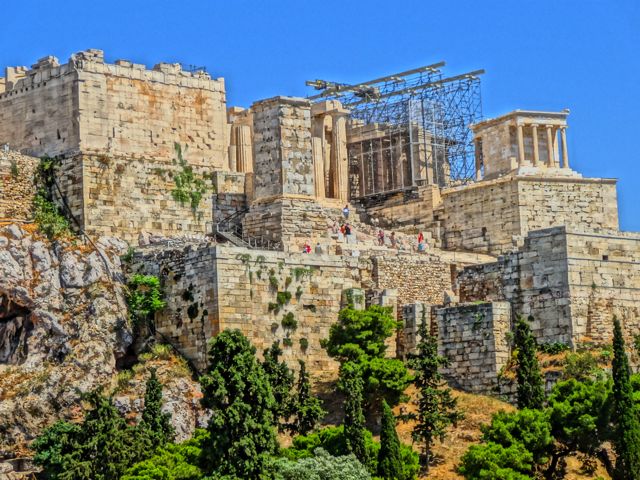
After climbing the steps you are at the entrance, or the Propylaea, which was completed in 432 just before the outbreak of the Peloponnesian wars. The main architect was Mnesicles, a colleague of Phidias. To your left is the Pinacotheca and a Hellenistic pedestal and on the right the tiny temple to Nike Athena or the Athena of Victory which commemorates the Athenians victory over the Persians. This small temple stands on a platform that overlooks the islands of Saronic Gulf and used to house a statue of Athena. It was dismantled by the Turks in 1686 so they could use the platform for a large cannon. It was rebuilt between 1836 and 1842 and again taken apart and rebuilt in 1936 when it was discovered that the platform was crumbing. If you looking from the propylaea towards Pireaus on a clear day you can see ships waiting outside the port of Pireaus, the islands and the mountains of the Peloponnesos beyond. |
|
|
|
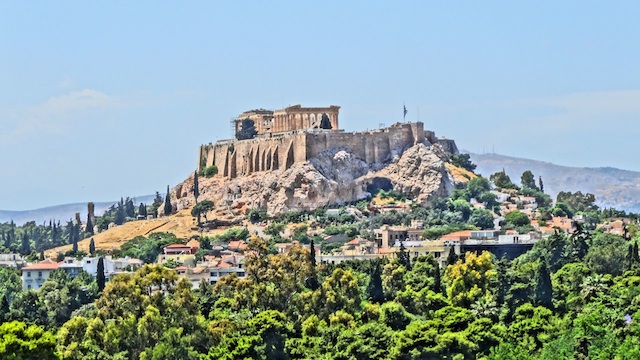
The Parthenon and other main buildings on the Acropolis were built by Pericles in the fifth century BC as a monument to the cultural and political achievements of the inhabitants of Athens. The term acropolis means upper city and many of the city states of ancient Greece are built around an acropolis where the inhabitants can go as a place of refuge in times of invasion. It's for this reason that the most sacred buildings are usually on the acropolis. It's the safest most secure place in town. As little as 150 years ago there were still dwellings on the Acropolis of Athens. Those of you who have read Aristophanes will recall that in Lysistrata the women have Athens barricaded themselves in the fortress in protest, being tired of their men going to war against Sparta. Depriving them of sex, cooking and care it was a terrific strategy that might even work today. Regardless, the play opened the door to the subject of sexual frustration in comedy and without it we might not have Woody Allen. Now days there are still protests which occasionally take place by site employees closing the Acropolis to tourists, some of whom have waited a lifetime to come to Greece. Thankfully these are rare and of short duration. |
|
|
|
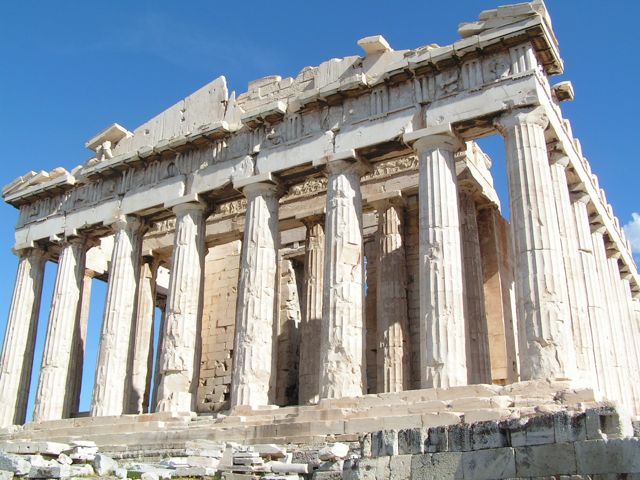
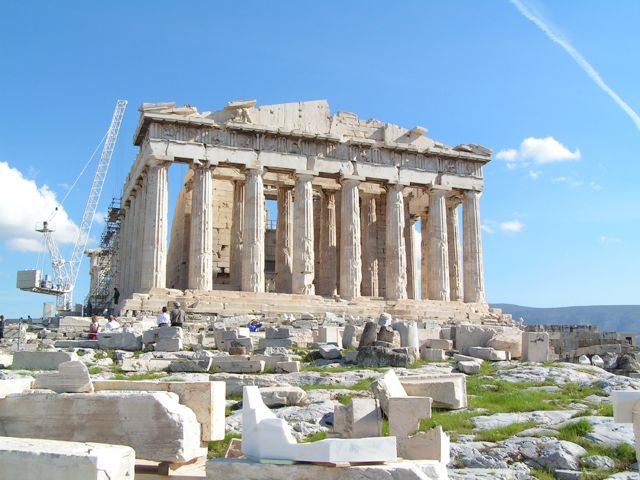
The best time to go up there is the late winter or spring when even this stone mountain is not immune to the proliferation of grass and wildflowers which seem to burst from every crack. Even in December, January and February the Acropolis can be surprisingly green. Even having seen a thousand photographs one is still not prepared for the immensity of the Parthenon. The building was designed by the architects Kallikrates and Iktinos as the home of the giant statue of Athena. It took 9 years to build and was completed in 438 BC and is probably the most recognizable structure in the world next to the golden arches of McDonalds. From a temple it became a church, a mosque and finally as a storage facility for Turkish gunpowder. In 1687 the Venetians bombarded it from below. A cannon ball hit the gun powder and blew it up. What makes the Parthenon so fascinating is that to look at it you would think that it is made up of inter-changable pieces. For example the columns are stones placed on top of each other and you could replace one piece of a column with any of the others. Not true. Each piece of the Parthenon is unique and fits together like the world's biggest and heaviest jigsaw puzzle. Lines that look straight are actually not. The ancient Greeks understood the mechanics of site and that to make a line look straight it had to be tapered or curved. The Parthenon is the most perfect and the most imitated building in the world. The restoration work you see has been going on for the last 30 years and may go on for another 30. The more they try to put it back together the more respect and awe they have for the ancient Greeks. |
|
|
|
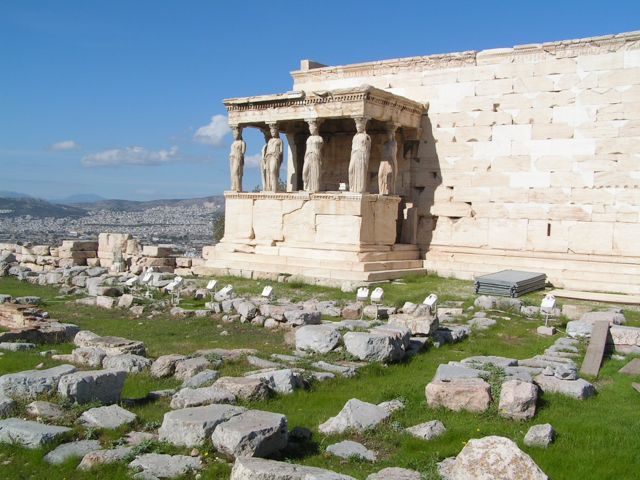
The Erecthion sits on the most sacred site of the Acropolis where Poseidon and Athena had their contest over who would be the Patron of the city. Poseidon thrust his trident into the rock and a spring burst forth, while Athena touched the ground with a spear and an olive tree grew. Athena was declared the victor and the great city of Athens was named for her while Poseidon was given a small village in Syros after it was discovered he had merely ruptured a water main. (not really. The building itself contains the porch of the maidens or Caryatids which are now copies, four of which have been placed in the Acropolis museum, hopefully to be reunited with a fifth taken from the Acropolis by Lord Elgin and put in the British Museum more than a century ago. Actually it is the Erecthion that is the real religious temple on the Acropolis. It sits in what was the northeast corner of what was the original temple, that was burned and destroyed by the Persians in 480 bc. The Parthenon, though we call it a temple, was not a place of worship. It was a built as a tribute commemorating the Greek victories over the Persians and it was used as a treasury to store the tribute paid by the other Greek city-states. So in other words the Parthenon was not considered holy. But the Erecthion was. |
|
|
|
A question in my mind is why not rebuild the Parthenon to it's former glory? It is not as if the destruction of it is sacred history that must be preserved, in fact the 300 years since the explosion is a relatively short time-span in the history of the building. Much of the Parthenon has been taken apart and put back together with pieces being replaced or clamped to remedy the wear and tear of centuries, in particular the last 20 or so years of air pollution. As it stands now, though it is a tribute to the glorious past and the achievement of the Ancient Athenians it is also at the same time a reminder that whatever is good in man is eventually overcome by ignorance, war and a hunger for domination. I say rebuild the entire Acropolis as an inspiration that whatever is wrong with the world can be righted. (Until some idiot blows it up again). |
|
|
|
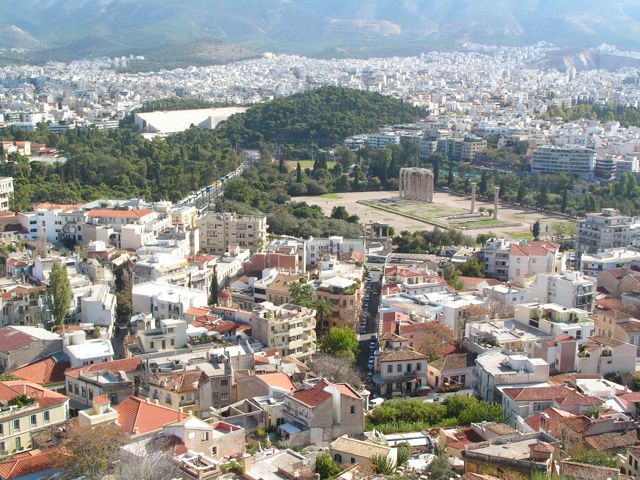
My favorite spot is at the flag on the northeast corner of the Acropolis where Athens stretches out endlessly below. You can see the ceramic tiled roofs of the houses in the Plaka beneath you, and if you look up Lysikratous Street you will see Hadrian's Arch and the ruins of the giant Temple of Olympian Zeus and the Olympic stadium nestled in a pine covered hill, an island of green in a sea of concrete. To the left of the stadium is the Zappion building and the National Gardens. To the right of the stadium you can see another large patch of green which is the First Cemetery. The Acropolis is a great place to get your bearings and get an understanding of the layout of the city. In fact the more you know Athens the more interesting it is to come up here and see familiar landmarks. |
|
|
|
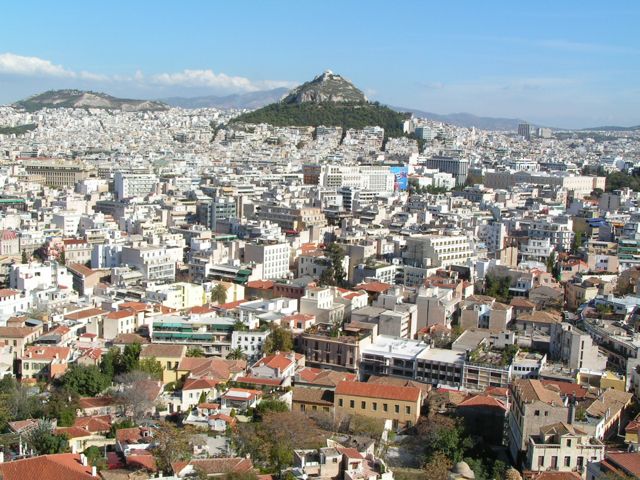
If you stand by the flag and look to your left you will see Mount Lycabettos rising from the neighborhood of Kolonaki , with the Hilton and the Athens Tower at Ambelokipi in the distance. The large green area is the National gardens. The Acropolis is a great place to get your bearings in Athens. You can see as far as Kifissia on a clear day. Before I forget to mention it, from the other side of the Acropolis, looking from the Propylea towards the sea, you can see Pireos Street which connects Athens to the port. This street follows one of the ancient long walls while the Athens metro tracks follow the other. This photo will show you what I mean. So back to the flag at the northeast corner of the Acropolis: When the Germans occupied Athens in WWII, the Evzone who guarded the Greek flag which flew from the Acropolis, was ordered by the Nazis to remove it. He calmly took it down, wrapped himself in it and jumped to his death. |
|
|
|
|
|
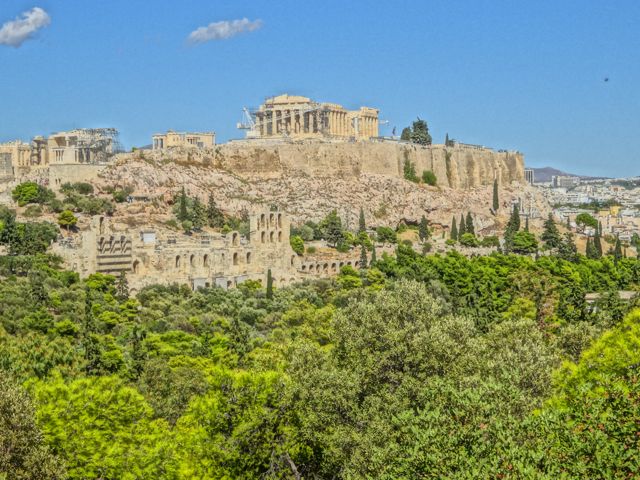
Below the Acropolis is the theater of Herod Atticus built by the Romans in 161 AD and still used today for classical concerts, ballet, performances of high cultural value and Yanni. Further on is the Theater of Dionysious the first stone theater and home to Sophocles, Aeschylus, Euripides and Aristophanes. It was rebuilt around 342 BC by Lykourgos and then enlarged by the Romans to be used for gladiator fights. In July of 2003 I saw Jethro Tull here. It was the first rock concert held in the ancient theater and though perhaps some people hope it was the last I would be happy to see more. How about Deep Purple with the Royal Philharmonic Orchestra performing Jon Lord's Concerto for Group and Orchestra? Maybe Procul Harum? Emerson, Lake and Palmer? The Stooges? Where's Leonard Cohen when you really need him? Beyond that is the Hill of Philippapos where people fly kites on Clean Monday. |
|
|
|
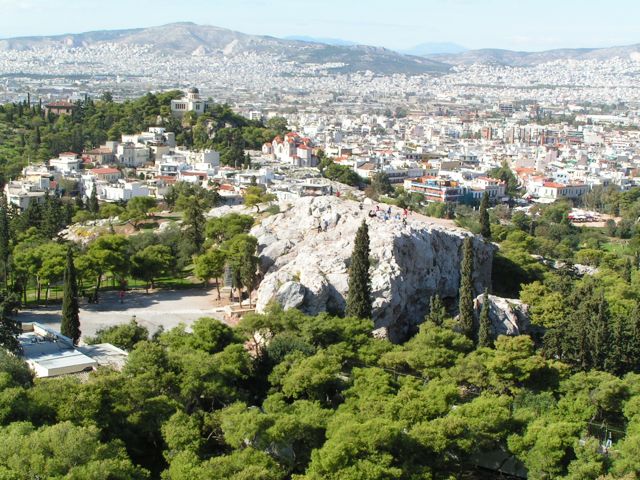
Below the Acropolis is the rock of Areopagos or what we called in high school 'Blow Hill'. (Don't ask). The steps are very slippery so be careful as you climb them, but once you do you won't want to come down (unless it is 100 degrees). You have a great view of the Agora, the Plaka, Monastiraki, Omonia and much of Athens. Great place to watch the sunset. Or come up at night with a bottle of wine and your true love, and watch the lights of the city. This is where Saint Paul spoke to the people of Athens in AD 51 and the tablet imbedded in the stone contains his words. There is a cleft in the rock at the bottom of the hill that is a shrine to the Furies. Afterwards, continue back around the Acropolis and down the hill into the Ancient Agora below. Part of it is free and you can go through it to get back to Adrianou Street, or you can pay the entrance fee and walk the streets of ancient Athens. If you decide to hang out awhile in the ancient Agora take a look at the rebuilt Stoa of Attalos, now a museum which features many of the every day items found in the area. |
|
Fun Fact! The ancient agora which to the untrained eye looks looks like a jumble of rocks and broken pavement (to the trained eye as well) was once a vibrant neighborhood and part of the Plaka and Monastiraki. The American School of Classical studies came in the fifties and kicked everyone out of their houses and businesses and demolished the buildings that had stood there for centuries to dig here. So next time you are walking through the Plaka and thinking that you wish there was more of Athens like this, remember that there used to be and be thankful that they did not destroy it all. But to be fair it is archaeological excavations like the agora which give Athens much of its precious green space. |
|
|
|
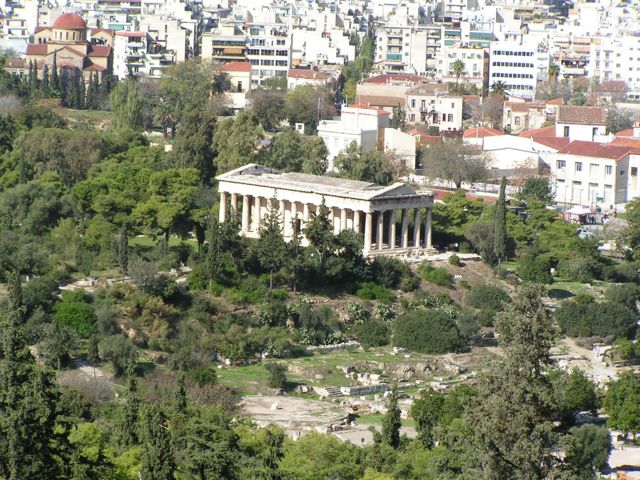
The small temple known as the Thission was built in 449 BC and is virtually intact. Supposedly named for Theseus because his exploits were shown on the frieze, it is now believed that it was actually a temple to Hephaestos and Athena. Unfortunately they realized their mistake too late and the entire neighborhood is called Thission. The temple was used as a Church, dedicated to Saint George, known as Saint George the Lazy because it was only open one day of the year. The neighborhood of Thission is full of cafes, bars and restaurants and like other areas around the Acropolis has been made pedestrian friendly, it's streets turned into walkways and landscaped with trees and flowers. You can read more about it on my Athens Agora Page |
|
Acropolis Guided Tours
Nadia provides the visitors with an understanding of the history and culture of ancient Greece that they won't get from reading a guidebook (or looking at a website for that matter). She is also excellent with high school and middle school as well as college students. For more information about Nadia or to book a tour visit her website. |
| Fantasy Travel's Acropolis Tours Fantasy Travel provides a licensed guide in their tours which feature the Acropolis and other important sites like the Acropolis Tour including the Acropolis Museum and their Half Day City Walking Tour. If you are coming with your kids I suggest the Acropolis Tour for Families. The Athens Walking Greek Mythology Tour will be a favorite of fans of Percy Jackson. The Athens Full Day Tour includes the Acropolis, the Acropolis Museum, a trip to the Temple of Poseidon at Cape Sounion and lunch. These tours pick you up and drop you off at your hotel and include all entrance fees. |
Acropolis Information |
|
|
|
The Acropolis is open from 8am to 6:30 pm every day. These hours can change depending on the season and sometimes it is open in the evening of the full moon in the summer. They don't allow you to bring backpacks or day bags on the Acropolis. You have to check them so if you need to bring a bag with you be sure to have a spare pocket for your valuables. The cost of entrance to the Acropolis is about 20 euros. They used to be included with the Acropolis ticket but you now need to buy individual tickets to the other nearby sites. The Acropolis Museum is nearby and that is not included in the Acropolis tickets. You can buy your tickets through Hellenic Heritage E-tickets. If you Google Acropolis tickets you will get a bunch of websites like Tripadvisor, Viator, and Get Your Guide that try to sell you their tours. The Acropolis ElevatorFor those who have difficulty with steps or are in wheelchairs there is an elevator on the northwest side of the Acropolis. If you ask when you get your tickets at the ticket booth they will point the way to you. If you are coming with a taxi and have mobility issues ask the driver to get your tickets and take you the rest of the way to the elevator. You should call the day of your visit to make sure that the lifts are working. (0030) 210 3214172 or (0030) 210 3214173. Get there as early as possible to avoid lines. Please keep in mind that this elevator is strictly available to disabled visitors and people assisting them only. That means you can't use it just because you don't feel like climbing the steps. And contrary to rumors you don't need to be in a wheelchair to use it but if you aren't bring a note from your doctor. Hi Matt, We arrived safely back from Greece...but I must tell you that there is much misinformation given re the elevator! After being told by workers on the Acropolis processing tickets that the elevator was only for those using wheelchairs, my very resourceful daughter, Aliya, went up to the elevator operators on the side of the ticket line....and was told yes, I can go up the elevator as long as I had a doctor s note stating that I needed to use
the elevator. I had the note. Up we went and after traveling 5,000 miles to Greece on my second and last trip, I had the privilege of seeing for myself the magnificent Parthenon and the old Temple of Athena. It was one of the highlights of my life. Also, I noted on the Acropolis that there were able bodied men and women who kept on trying to use the elevator and seeming to try and bribe the elevator who had a difficult time with them. Walking to the Acropolis One way to get to the Acropolis is to walk up from the Plaka and keep climbing until you come to the small road that goes around it and head west (to your right). The entrance is up from the rock of Areopagos. The easiest way is to follow Dioysiou Aeropagitou, the large pedestrian street that starts near Hadrian's Arch and goes around the south side of the Acropolis until you come to the marble paths that lead up the hill. This road becomes Apostolou Pavlou which is also car-less and continues past the cafes of Thission to the lower Ermou and Kerameikos archaeological site which is at the bottom of Monastiraki. Coming from a Cruise Ship If you are coming from a cruise ship the best thing to do is take a taxi, either pre-arranged with George the Famous Taxi Driver, or with one of those waiting at the port. If you use George you can do an Athens tour and he can take you back to the boat. If you just grab a cab at the port they are probably going to talk you into doing a tour anyway so you may as well use George so you know that you are getting someone who speaks English and knows what he is talking about. For those who want to take the metro just walk to the Pireaus metro station which is about 20 minutes from the cruise terminal (with the harbor on your left, the city on your right). You will see a pedestrian bridge right at the station. Take the metro to Thission and when you get out of the station walk to your right and follow the people to the entrance. You can go back the way you came or take the metro from Monastiraki Station. If you get on the metro at Acropolis or Syntagma you will have to change trains to go back to Pireaus. Convenient Hotels to the Acropolis
|
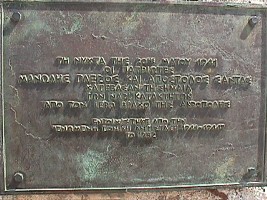 The plaque by the flag commemorates Manolis
Glezos and Apostolis Santas, the two eighteen year-old heroes who
tore down the Nazi flag flying
from the Acropolis on the night of May 30th, 1941.
It is of particular interest
because these names are known
not only by Greeks, but by
many Europeans, because this
act of courage and
resistance to Nazi oppression
was an inspiration to all
subjected people. Later through reading
the book
Athens:The City by John
Tomkinson I found out that
Glezos, who became a member of
the Greek resistance, was
condemned to death for treason
in 1948 and imprisoned for
being a communist. He was later elected a member of the Panhellenic Socialist Party (PASOK) and then a member of the SYRIZA party until he got angry with them and quit.
The plaque by the flag commemorates Manolis
Glezos and Apostolis Santas, the two eighteen year-old heroes who
tore down the Nazi flag flying
from the Acropolis on the night of May 30th, 1941.
It is of particular interest
because these names are known
not only by Greeks, but by
many Europeans, because this
act of courage and
resistance to Nazi oppression
was an inspiration to all
subjected people. Later through reading
the book
Athens:The City by John
Tomkinson I found out that
Glezos, who became a member of
the Greek resistance, was
condemned to death for treason
in 1948 and imprisoned for
being a communist. He was later elected a member of the Panhellenic Socialist Party (PASOK) and then a member of the SYRIZA party until he got angry with them and quit. 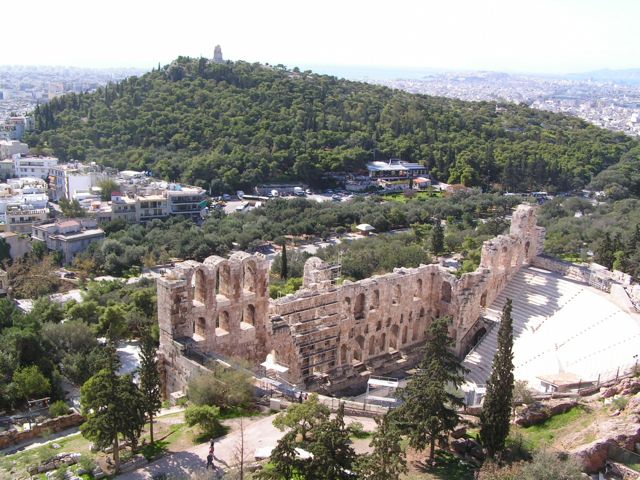
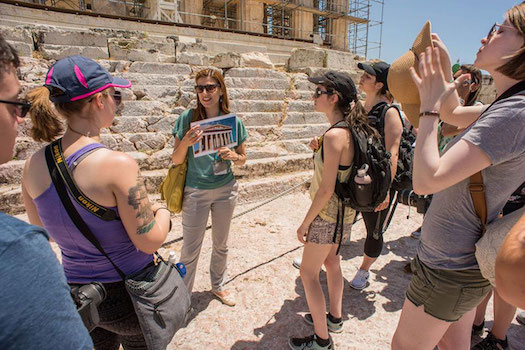 If you need a guide for the Acropolis, the Acropolis Museum or any of the other archaeological sites in Athens and the surrounding area I recommend Nadia Pavlikaki who is an archaeologist, art historian and a licensed tour guide with an infectious passion for her city and its history. She offers mainly private tours for small parties
(of 2 to up to 10 people). When there are two requests for the same day and for the same site, a shared tour can be arranged, but must be planned weeks ahead.
If you need a guide for the Acropolis, the Acropolis Museum or any of the other archaeological sites in Athens and the surrounding area I recommend Nadia Pavlikaki who is an archaeologist, art historian and a licensed tour guide with an infectious passion for her city and its history. She offers mainly private tours for small parties
(of 2 to up to 10 people). When there are two requests for the same day and for the same site, a shared tour can be arranged, but must be planned weeks ahead.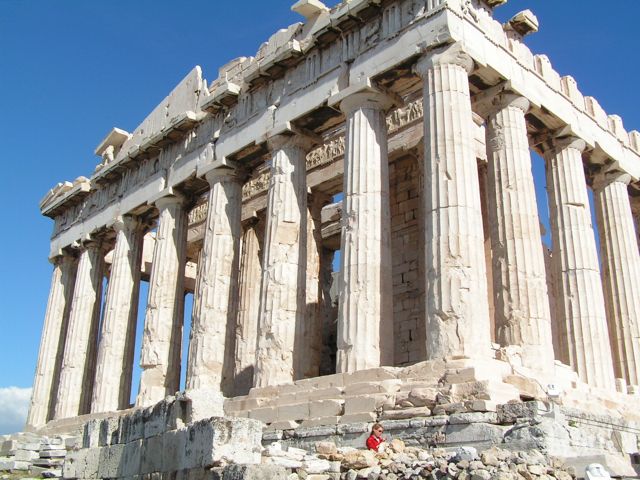
The Elgin Marbles: What's the Big Deal? |
|
But nothing is ever black and white so visit my website on Lord Elgin and the Parthenon Marbles which also includes more details on the history of the Acropolis and some great photos. See my photo journey On The Acropolis and Inside the Parthenon |
|
See Helpful Information for Wheelchair Users from an Athens 2004 Paralympic Athlete Other Acropolis Info: Acropolis Photos, Elgin Marbles, and History of Greece For private tours of Athens be sure to visit George the Famous Taxi Driver who will pick you up at your hotel, the airport, the port or anywhere you like and show you the city in style in his luxury Mercedes visiting as many museums and archaeological sites as you can fit into a day. |
|
|
Powered by GetYourGuide |
 No doubt you have heard of the controversy
surrounding the Elgin Marbles. These are the
choice pieces of the frieze on the Parthenon, one
of the maidens from the Erechthion and many other
artifacts which were 'sold' to the British Lord
Elgin by the Turks who were occupying
Greece. They are now in the British Museum for
'safe keeping' though the Greek Government, the
Greek people and just about everyone else in the
world with the exception of the British government
believe that they should be returned. To put a
contemporary face on the situation if someone
broke into your house, held you hostage and sold
your Picasso collection to your neighbor you would
expect your neighbor to return it. In this case
the neighbor says "No, these are mine. I bought
them."
No doubt you have heard of the controversy
surrounding the Elgin Marbles. These are the
choice pieces of the frieze on the Parthenon, one
of the maidens from the Erechthion and many other
artifacts which were 'sold' to the British Lord
Elgin by the Turks who were occupying
Greece. They are now in the British Museum for
'safe keeping' though the Greek Government, the
Greek people and just about everyone else in the
world with the exception of the British government
believe that they should be returned. To put a
contemporary face on the situation if someone
broke into your house, held you hostage and sold
your Picasso collection to your neighbor you would
expect your neighbor to return it. In this case
the neighbor says "No, these are mine. I bought
them."

|
|
|
|
|
|

Return to Athens Survival Guide
Join Matt Barrett's Greece Travel Guides Group on Facebook for comments, photos and other fun stuff. If you enjoy this website please share it with your friends on Facebook. If you are appreciative of all the free information you get on my websites you can send
a donation through Paypal or you can use Venmo
Or you can mail a check to: Greecetravel.com/102 Old Pittsboro Rd/Carrboro, NC 27510 USA